Last reviewed: October 2026 · Lisa Craven, Managing Director, FridgeSmart
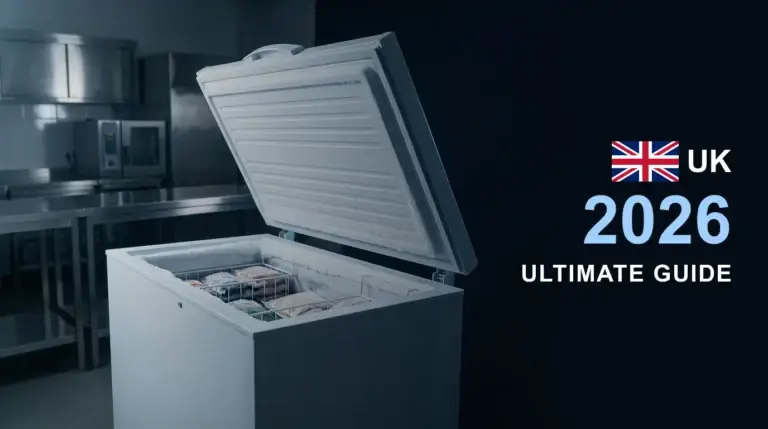
A commercial chest freezer stores frozen stock at -18°C or below — the UK industry standard — at some of the lowest running costs of any commercial refrigeration equipment — from just 30p a day for a 557-litre unit. This guide covers every TEFCOLD GM model, the Eco Design myth, and the capacity planner to find your right size.
Key Facts: Commercial Chest Freezers (UK, 2026)
- Storage temperature: UK law sets no single legal temperature for frozen food — the Food Safety (Temperature Control) Regulations 1995 cover the 8°C chilled limit only. −18°C or below is the universal standard, is what EHOs expect to see in your HACCP records, and applies to storage and display freezers alike
- Operating range: The TEFCOLD GM range is adjustable from −14°C to −24°C, so it holds −18°C with margin to spare; Climate Class 4 (rated to +30°C ambient)
- Chest vs upright: Chest freezers retain cold air better when opened (cold air falls, warm air rises); upright freezers offer better stock organisation but higher energy use when doors are opened frequently
- TEFCOLD GM range: GM200 (185L), GM300 (273L), GM400 (377L), GM500 (454L), GM600 (557L net) — white lid, or SS suffix for a stainless steel lid; all R600a, manual defrost. The SE range is the −45°C ultra-low-temperature option
- SE20-45 specifications: 984×705×945mm, 230L net capacity, 3.55 kWh/day — approximately £376/year at 29p/kWh UK commercial rate (2026)
- R600a refrigerant: GWP 3 — same environmental profile as R290; qualifies for 100% Annual Investment Allowance in the year of purchase
- Defrost: Manual defrost — build-up of more than 6mm ice reduces efficiency significantly; schedule defrost when stock is low
Commercial Chest Freezer Guide 2026
557 litres of frozen storage.
30p a day to run it.
The TEFCOLD GM600SS is a 557-litre commercial chest freezer that costs £657 to buy and just £110 a year to run — that’s 30p a day. This guide explains which size you need, what the model numbers mean, and why the “Eco Design” label doesn’t always mean what you think.
✓ 6 models compared
✓ Real prices & running costs
✓ Capacity planner included
✓ Eco Design myth busted
A commercial chest freezer is one of the simplest, most reliable pieces of equipment in any kitchen, prep room, or storage area. No complicated controls, no fan noise, no glass doors to clean — just a well-insulated box that keeps your frozen stock at temperature, day and night, for about a penny an hour.
The buying decision comes down to three things: the right size, the right type, and not falling for the “Eco Design” trap. Here is how they compare.
⚡ Myth Buster — Read This First
“Eco Design” Doesn’t Mean More Efficient
On FridgeSmart, you’ll see two ranges of commercial chest freezer: the classic TEFCOLD GM range and the newer TEFCOLD LHF ECO DESIGN range. The word “Eco Design” sounds like it should mean lower energy use. It doesn’t.
“Ecodesign” means the unit is declared compliant with the UK/EU Ecodesign rules for its product class — minimum efficiency and information requirements for that class. It is a pass/fail badge, not a ranking. A compliant unit is not automatically cheaper to run than a unit in a different class, and the kWh/24h on the spec sheet is what you actually pay for.
Here’s the actual comparison for two units at similar sizes:
✓ TEFCOLD GM600SS — £657
Capacity: 557 litres
Energy: 1.04 kWh/day
Running cost: £110/year
Climate class: 4 (works up to 30°C)
✗ TEFCOLD LHF620SS ECO DESIGN — £882
Capacity: 426 litres net
Energy: 2.02 kWh/day
Running cost: £214/year
Climate class: 3 (max 25°C only)
The “Eco Design” unit costs £184 more to buy, holds 131 litres less stock, and costs £104 more per year to run. Over five years you pay £704 more to own it. One caveat: the LHF620SS carries a better energy-label grade (C) than the GM600SS (F) because the label is a volume-adjusted index, not a kWh figure — compare the kWh/24h on the spec sheets, which is what you pay for.
The 4 Types of Commercial Chest Freezer
📦
Standard Commercial
From £353 — GM Range
The workhorse. Solid hinged lid, R600a refrigerant, -14 to -24°C. Sizes from 185L to 557L. Climate Class 4 — works in kitchens up to 30°C. What most businesses need.
🥩
Ultra-Low Temperature
From £509 — SE & EL LT Range
Reaches down to -45°C. Required for storing certain seafood, scientific samples, or premium meat products needing deep-freeze storage beyond the standard -18°C minimum.
🍦
Ice Cream Display
From £421 — ST & CF Range
Glass hinged lid for visibility — customers can see and select product. The ST160 has a single hinged glass lid. The CF700 SL is the large-format ice cream display version. Not for back-of-house storage.
🌿
Eco Design Compliant
From £657 — LHF & EL Range
Meets the UK/EU Ecodesign Directive. Lower profile (861mm vs 945mm) and catering-grade stainless lid. Climate Class 3 — see the myth-buster above before buying based on the “Eco” label alone.
Annual Running Costs — The GM Range
At 29p/kWh (UK commercial average, 2026), the entire TEFCOLD GM chest freezer range is remarkably cheap to run. These are real figures from the product spec sheets:
LHF620SS ECO (426L)
£214/yr
Context check: £110/year for a 557-litre commercial freezer is less than £2.12 per week. Static chest freezers are among the most energy-efficient refrigeration equipment in commercial catering.
Capacity Planner: What Fits in Each Size?
Chest freezer capacity figures (in litres) don’t always translate clearly to “how much stock can I store?” Here’s a practical breakdown for each model size, based on standard 1kg product packaging:
185L
net capacity
~120 × 1kg meal pouches
~60 × 1kg premium cuts
~90 × 500g fish fillets
~180 litres ice cream
From £353
273L
net capacity
~180 × 1kg meal pouches
~90 × 1kg premium cuts
~130 × 500g fish fillets
~270 litres ice cream
From £482
377L
net capacity
~245 × 1kg meal pouches
~120 × 1kg premium cuts
~185 × 500g fish fillets
~375 litres ice cream
From £493
454L
net capacity
~300 × 1kg meal pouches
~150 × 1kg premium cuts
~220 × 500g fish fillets
~450 litres ice cream
From £536
557L
net capacity
~370 × 1kg meal pouches
~185 × 1kg premium cuts
~270 × 500g fish fillets
~550 litres ice cream
From £657
Don’t fill to the brim. UK food hygiene best practice (and HACCP principles) requires adequate airflow inside a freezer. Don’t pack stock so tightly that items in the centre can’t cool properly. Leave roughly 10–15% headroom — so a 454-litre GM500 should be used to around 380–400 litres of stock.
6-Model Comparison Table
| Model |
Price (ex VAT) |
Capacity |
Dimensions (W×D×H) |
Temp Range |
Energy/Day |
Run Cost/Year |
Refrigerant |
|
Entry
|
£353 |
185L net |
734 × 700 × 945 mm |
-14 to -24°C |
0.65 kWh |
£69 |
R600a |
|
Was £759
|
£482 |
273L net |
984 × 700 × 945 mm |
-14 to -24°C |
0.74 kWh |
£78 |
R600a |
|
Mid
|
£493 |
377L net |
1,284 × 678 × 920 mm |
-14 to -24°C |
0.85 kWh |
£90 |
R600a |
|
Was £844
|
£536 |
454L net |
1,504 × 700 × 945 mm |
-14 to -24°C |
0.93 kWh |
£99 |
R600a |
|
Best Value Large
|
£657 |
557L net |
1,804 × 700 × 945 mm |
-14 to -24°C |
1.04 kWh |
£110 |
R600a |
|
Ultra-Low
|
£651 |
230L net |
984 × 705 × 945 mm |
Down to -45°C |
3.55 kWh |
~£376 |
R290 |
All prices ex VAT. Running costs at 29p/kWh. Capacities, dimensions and energy figures from the TEFCOLD UK spec sheets. The SE20-45’s higher energy consumption is inherent to ultra-low temperature operation. Click any model name to view on FridgeSmart.
Cracking the Model Numbers
🔍 TEFCOLD & Elcold Chest Freezer Decoder
GM200 / GM300 / GM400 / GM500 / GM600
TEFCOLD commercial chest freezer. Number = approximate capacity class in litres. SS suffix = stainless steel lid (food-safe, easier to clean). All use R600a refrigerant, Climate Class 4.
LHF460 / LHF540 / LHF620
Low-Height Freezer. Lower profile unit (861mm H vs 945mm). ECO Design compliant. Number = approximate gross capacity in litres. SS suffix = stainless steel lid (304-grade catering spec).
SE10-45 / SE20-45 / SE30-45 / SE40-45
TEFCOLD ultra-low temperature. First number = approximate size. -45 = reaches down to -45°C. R290 refrigerant. For specialist applications: scientific storage, premium seafood, high-end butchery.
EL22 / EL35 / EL45 / EL53 / EL61 / EL71
Elcold ECO Design standard range. Number = gross capacity in hundreds of litres (EL22 = 220L class, EL71 = 710L class). SS suffix = stainless lid. R600a refrigerant.
EL11LT / EL21LT / EL31LT / EL41LT / EL51LT
Elcold Low Temperature (-45°C) range. LT = Low Temperature. Number = approximate capacity class. Higher energy consumption than standard range due to ultra-low temperature requirement.
ST160 / CF700 SL
ST160 = hinged glass lid display freezer, 105L net. CF700 SL = ice cream chest freezer with sliding lid, 700L class. Both are front-of-house display units — not for back-of-house storage.
5 Things to Check Before You Buy
🌡️
Climate Class: 3 vs 4
Climate Class 4 (max 30°C ambient) covers most UK storerooms and prep areas; a busy cook line in summer can exceed 30°C, so site the freezer away from the ovens. The entire
TEFCOLD GM range is Climate Class 4. The LHF Eco Design range is Class 3 (max 25°C) — potentially a problem in a hot kitchen or an unventilated storage room in summer.
🔒
Lock as Standard
All TEFCOLD GM models come with a lid lock as standard — useful in catering environments where stock security matters. Check whether the lock is keyed or padlock-style if this is important for your operation.
🛞
Castors on Every GM Model
All
TEFCOLD GM chest freezers come with 4 double castors — they can be repositioned for cleaning or moved between storage areas without heavy lifting. The LHF Eco Design range stands on feet rather than castors.
🧊
Manual Defrost
All chest freezers in this category use manual defrost — you periodically switch off, empty, and defrost the unit. This typically happens every 3–6 months in normal commercial use. Build this into your operations schedule. It’s the trade-off for the low energy consumption — auto-defrost freezers use significantly more electricity.
🔋
R600a Refrigerant
The entire GM and standard Elcold EL range uses R600a (isobutane) — a natural refrigerant with a GWP of just 3. This is as environmentally benign as commercial refrigerants get, and it’s not subject to the F-gas phase-down rules affecting HFC refrigerants. See the
UK F-gas Regulations guidance for full details on which refrigerants are affected. Future-proof against refrigerant phase-downs.
📏
Height: Standard vs Low Profile
The GM range stands 945mm tall (the GM400 is 920mm) — just above worktop height, easy to access. The LHF Eco Design range stands 861mm — lower, which can be useful under worktops but means slightly less reach depth into the unit. The GM range is 700mm deep (GM400: 678mm); the LHF is 729mm. Measure your space before ordering, especially if it’s going under a fixed worktop.
Choosing the Right Size
-
1
Cafés, small takeaways, small hotel kitchens: The GM200 (185L, £353) or GM300SS (273L, £482) covers most needs. If you’re primarily storing ice cream, desserts, and the occasional frozen supplier delivery, either is adequate.
-
2
Pub kitchens, mid-size restaurants, care homes: The GM500 (454L, £536) is the right scale — enough capacity for weekly bulk deliveries of frozen protein, veg, and desserts without daily restocking.
-
3
Large kitchens, butchers, fishmongers, catering companies: The GM600SS (557L, £657) is the largest single-unit standard chest freezer in the range. For storage beyond 557L, consider two GM500 units side by side — £1,110 for 908 litres, more flexible, and you retain freezing capacity if one needs servicing.
-
4
Scientific, pharmaceutical, or premium seafood storage needing -45°C: The TEFCOLD SE range (from £509) or the Elcold LT range (from £868) are purpose-built for ultra-low temperature. Standard commercial chest freezers only reach -24°C — they cannot safely store products requiring temperatures below -30°C.
-
5
Front-of-house ice cream display: The ST160 (£421) or CF700 SL (£846) are the right choice. Solid-lid chest freezers are back-of-house equipment — customers can’t see through an opaque lid. If it’s going in view of the customer, you need a glass lid. For display freezers that customers can see into, see our ice cream freezer buying guide.
💡 Two smaller units vs one large unit: For high-volume operations, two GM500 units (£536 × 2 = £1,110) can actually be smarter than one oversized unit. Total capacity is 908L vs 557L, you have redundancy if one needs servicing, and you can dedicate one to each product type (fish/meat in one, vegetables/desserts in the other) — eliminating any cross-contamination risk and simplifying stock rotation.
Food Safety & Legal Requirements
UK Food Safety (Temperature Control) Regulations: The
Food Safety (Temperature Control) Regulations 1995 set the 8°C chilled limit and do not set a legal temperature for frozen food. −18°C or below is the universal standard and what inspectors expect to see in your records. All
TEFCOLD GM chest freezers achieve -14 to -24°C, which comfortably maintains -18°C. Record freezer temperatures daily as part of your HACCP temperature log and keep the logs for at least 12 months (good practice, not law) — your local authority EHO will ask for them.
-
✓
Monitor with a separate thermometer. The built-in thermometer on the GM range reads cabinet air temperature, not product temperature. For HACCP compliance, use a calibrated probe thermometer to check product core temperature periodically — especially after a large delivery is loaded.
-
✓
Load deliveries in stages where possible. Adding a large quantity of warm or defrosted product all at once forces the compressor to work hard and can temporarily raise the cabinet temperature. Load in smaller batches or pre-chill product if practical.
-
✓
Do not refreeze raw product that has thawed. FSA guidance is to cook thawed food within 24 hours and only refreeze it once cooked. Date-mark everything on entry and operate strict FIFO (first in, first out) stock rotation.
-
✓
Allow the gap in the manual — typically 100mm — at the sides and rear. Commercial chest freezers need airflow around the condenser and compressor compartment. Don’t push the unit flush against walls on all sides — restrict airflow and you increase energy consumption and shorten compressor life.
Keeping It Running: Simple Maintenance
-
1
Defrost every 3–6 months. Manual defrost chest freezers require you to empty, switch off, defrost, clean, and reload periodically. Plan this during a stock-low period (e.g. just before a supplier delivery day). The defrost drain on the GM range makes this straightforward — have towels and a container ready.
-
2
Clean the condenser every three months, more often in dusty or greasy environments. The GM range uses a skin condenser built into the cabinet walls, so there is no coil to brush — keep the outer walls dust-free and the compressor grille clear. On models with an exposed coil (the SE range), dust and grease on the fins force the compressor to work harder; a vacuum or soft brush is all you need.
-
3
Inspect the lid seal quarterly. A worn or cracked lid gasket allows warm air in, increases energy consumption, and can create compliance issues with temperature maintenance. The paper test: press a sheet of paper in the lid seal. If it slides out easily with the lid closed, the seal needs replacing.
-
4
Keep the lid closed except when loading/unloading. Every minute a chest freezer lid is open, warm ambient air floods in. Train staff to close immediately after access — this single habit can reduce energy consumption by 5–10% in busy kitchens.
-
5
Don’t store in direct sunlight or near heat sources. Placing a chest freezer next to a commercial oven, dishwasher, or in a south-facing room with a window causes the unit to run continuously to compensate. The GM range is Climate Class 4 (up to 30°C) but thermal loading from nearby heat sources can still increase running costs significantly. To cut your freezer running costs further, read our guide to cutting commercial fridge energy bills.
Alongside chest freezers, many kitchens need a walk-in cold room for chilled storage. Our cold room buying guide covers capacity planning, temperature zones, and installation.
In Summary
A commercial chest freezer is a top-opening bulk frozen storage unit used by restaurants, caterers, food retailers, and food production businesses. UK law sets no single legal temperature for frozen food; −18°C or below is the universal standard and what EHOs expect to see in HACCP records. TEFCOLD’s GM range (185L–557L net, white or stainless steel lid) is adjustable from −14°C to −24°C, Climate Class 4, and uses R600a refrigerant (GWP 3), qualifying for 100% Annual Investment Allowance. The GM600SS (557L) uses 1.04 kWh/day — approximately £110/year at 29p/kWh (2026). The SE range reaches −45°C for ultra-low-temperature storage: the SE20-45 (230L) uses 3.55 kWh/day, approximately £376/year. Chest freezers retain cold air more efficiently than uprights when opened frequently. Manual defrost should be scheduled when ice build-up exceeds 6mm. FridgeSmart stocks the full TEFCOLD chest freezer range with UK-wide delivery.
Frequently Asked Questions
What’s the difference between a commercial chest freezer and a domestic one?
▼
Three things: duty cycle, build quality, and what you can prove. Domestic chest freezers are designed for moderate use in a home garage or utility room. Commercial models like the
TEFCOLD GM range are rated Climate Class 4 (up to 30°C), built for continuous high-duty cycles in commercial kitchen environments, and include features like lid locks, defrost drains, and commercial-grade compressors designed to last 10+ years. Using a domestic unit in a commercial kitchen will usually fall outside the manufacturer’s warranty and may breach your business insurance conditions.
Do I need a chest freezer or an upright freezer?
▼
Chest freezers are significantly more energy-efficient than upright freezers for back-of-house storage — cold air doesn’t fall out every time you open the lid (unlike upright freezer doors). They also maintain temperature better during power outages — a full chest freezer will hold temperature for around 48 hours unopened, and uprights lose cold faster every time the door opens. The downside is access — you have to reach down into a chest freezer, which is harder for frequently-accessed items. If your staff need to access the freezer many times per hour for service, an upright may be worth the extra energy cost for ergonomic efficiency. For bulk storage accessed a few times a day, a chest freezer wins every time.
Can I store raw meat and cooked food in the same chest freezer?
▼
Technically yes, if the products are properly wrapped and separated. UK FSA guidance for commercial food businesses recommends storing raw meat below ready-to-eat foods to prevent cross-contamination from drip. In a chest freezer, this means raw meat on the bottom and cooked/ready-to-eat products in baskets or containers above. In practice, many commercial kitchens use separate units for raw and cooked — the
GM500 and
GM300SS together at under £1,010 is a sensible setup for a mid-size kitchen.
How cold does a commercial chest freezer need to be by law?
▼
The
Food Safety (Temperature Control) Regulations 1995 set the 8°C chilled limit and do not set a general legal temperature for frozen food. −18°C or below is the universal UK standard, is written into the rules for specific quick-frozen and animal-origin products, and is what EHOs expect to see in your records. The TEFCOLD GM range operates between -14°C and -24°C — set towards the cold end, it easily maintains -18°C or below. For ultra-low temperature applications (certain seafood, pharmaceutical products), the
SE-45 range reaching down to -45°C is required. Always record temperatures daily in your HACCP temperature log.
Should I buy the SS (stainless lid) version or the standard version?
▼
The price difference is small: the
GM200SS is £405 vs £353 for the standard GM200. For the GM300SS vs GM300, it’s £482 vs £460. The stainless steel lid is easier to clean, more hygienic in a commercial environment, and more resistant to denting. If you’re placing it in a food preparation area where hygiene inspectors will see it, the SS lid is worth having. If it’s in a locked dry store accessed once a day, the standard white lid is fine.
What does R600a refrigerant mean and do I need an engineer to service it?
▼
R600a is isobutane — a natural hydrocarbon refrigerant with a Global Warming Potential (GWP) of just 3, compared to 1,430 for the older R134a. It’s the most environmentally benign common refrigerant available. R600a is a hydrocarbon, not an F-gas, so the F-gas certification rules do not apply at any charge size (all GM models carry 110g or less). Routine maintenance — cleaning, seals, thermostat — needs no refrigerant qualification at all. Anything that opens the sealed circuit, such as a compressor replacement or leak repair, must be done by a refrigeration engineer trained on flammable hydrocarbon refrigerants; the system is sealed and is never topped up.
How long do commercial chest freezers last?
▼
A well-maintained commercial chest freezer should last 10–15 years. The most common failure points are: the compressor (typically 10–15 years), the lid seal/gasket (replace every 3–5 years as needed), and the thermostat (can fail after 5–8 years but is an inexpensive repair). Because the
TEFCOLD GM range uses static cooling (no fan) with minimal moving parts, there’s relatively little to go wrong. The low purchase price also means that when a unit does reach end-of-life after a decade, replacement is straightforward and affordable.
Browse Commercial Chest Freezers at FridgeSmart
39 models available — from £421 glass-lid display units to 557-litre back-of-house workhorses. All prices ex VAT, Climate Class 4 models available for hot kitchen environments.
View All Chest Freezers →