How Much Profit Can an Ice Cream Freezer Make? The Complete UK Guide (2026)
- Lisa Craven
Last reviewed: October 2026 · Lisa Craven, Managing Director, FridgeSmart
A commercial ice cream freezer keeps products at the industry-standard -18°C while maximising impulse sales through open-top or glass-lid display. This guide covers every type, the running costs, and which model suits your business — with real prices.
- Storage temperature: Ice cream is stored and displayed at −18°C or below — FSA guidance and the figure every supplier contract specifies; the Food Safety (Temperature Control) Regulations 1995 set only the 8°C chilled limit
- Operating range: Commercial ice cream display freezers typically maintain −18°C to −24°C — suitable for pre-packaged and scoop ice cream display
- Refrigerant: R290 (propane, GWP 3) — natural refrigerant, no F-gas phase-down exposure
- Climate class: TEFCOLD’s IC sliding-lid and scoop ranges are rated Climate Class 5 (40°C ambient) — built for a hot shop, a sun-facing window or a marquee at a summer event
- Chest vs upright: Chest-style ice cream freezers retain cold air better when opened (cold air falls); upright display freezers offer better product visibility for self-service
- Lid types: Flat glass lids maintain compliance temperature while allowing product visibility — the standard format for impulse-sale display of pre-packaged ice cream
- Supplier: TEFCOLD commercial ice cream freezers — models available from FridgeSmart, delivered UK-wide
Summer 2026 is done. If your freezer earned its keep, you already know the answer to the question in the title. If you spent August watching customers walk out to the shop down the road, this is the time to fix it — autumn and winter are when lead times are shortest, and a freezer installed now is run in and paid for before the first hot weekend of 2027.
The numbers below are for a convenience store, at 2026 wholesale and retail prices.
Ice cream is the highest-margin impulse product most shops can stock. It doesn’t require a licence. It doesn’t go out of date overnight. Demand arrives with the weather. The only thing standing between you and that profit is having the right freezer in the right spot.
This guide runs the numbers honestly — what a commercial ice cream freezer actually costs, what you can realistically make, and how quickly it pays for itself.
The Market Opportunity Right Now
The UK ice cream market hit £1.6 billion in 2025 — a 12.7% increase year on year, according to the Ice Cream Alliance. And the fastest growing channel wasn’t supermarkets. It was convenience stores, up 16.5%.
Ice cream isn’t a nice-to-have for your shop. It’s the anchor of your entire frozen category. If you’re not stocking it properly, you’re handing that sale to the shop down the road.
Trade data puts ice cream at 37% of all frozen category sales in UK convenience stores. It’s not a seasonal extra — it’s a core product line.
The Profit Maths — Let’s Run the Numbers
This is what most suppliers won’t spell out clearly. Here it is in plain English.
Impulse ice cream — individually wrapped products like Magnums, Cornettos, Calippos — typically returns around 35% profit on return at RRP once VAT is taken off (ice cream is standard-rated) — more if you price above RRP, which most convenience stores do on impulse lines.
Here’s what that looks like for a single freezer over one summer, at 2026 prices:
🍪 Single Freezer — Summer Profit Estimate
60 units
~£1.15 ex. VAT
£2.20 inc. VAT (£1.83 net)
68p
£41
2×
13 weeks
£1,061
That’s one product line, one freezer, one summer. Stock a mix of brands and formats — multipacks, premium tubs, kids’ lollies — and the numbers go up significantly.
Cornetto came second at £11.8m. These products sell themselves — your job is to have them in stock and visible.
What Does a Freezer Actually Cost to Buy and Run?
Let’s tackle the upfront question head on.
Purchase cost
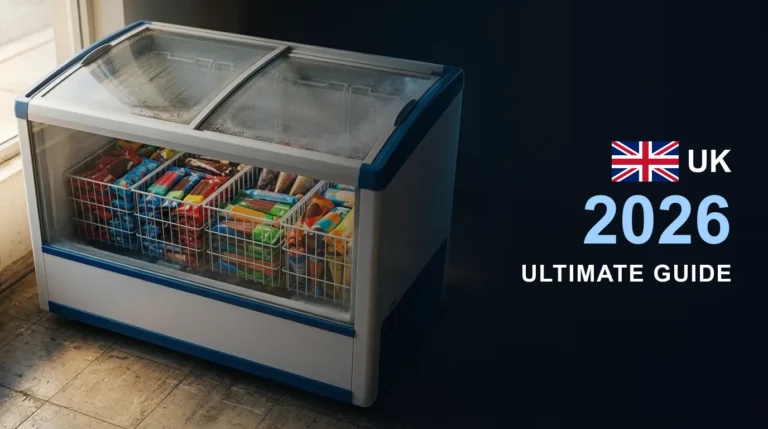
Entry-level sliding lid chest freezers start from around £410 ex. VAT (TEFCOLD IC-SC range, £410–£840 depending on size). Where floor space is tight, the TEFCOLD ST160 hinged glass lid chest freezer is the compact impulse option. Scoop display freezers with a glass canopy for serving loose ice cream run around £590–£930 ex. VAT in the TEFCOLD IC-SC-SO range; the TEFCOLD CF700 SL is a solid-lid storage freezer for back-up stock, not a display unit. The type you need depends on your space and how much volume you expect to move.
Running costs
A commercial chest freezer typically uses 1–3 kWh per day. At current UK commercial electricity rates of around 28–34p per kWh, that works out at roughly:
Even at the higher end, that’s about £1 a day in electricity. Against around £1,060 in summer gross profit from one freezer, the running cost is a rounding error. Keep frozen stock at -18°C or below — see the FSA chilling guidance for the full legal requirements.
How fast does it pay back?
📅 Payback Calculation — Mid-Range Freezer
-£700
-£200
+£1,061
+£161 profit
The freezer pays for itself in the first summer. Every summer after that — and every autumn and winter as the category grows year-round — is pure profit on top.
Every summer after that is profit.
The Five Objections — Answered
Here are the five things that stop shop owners buying. Here’s the honest answer to each one.
As shown above, a mid-range freezer pays for itself in a single summer season. If even that feels like a stretch, entry-level units start from around £410 ex. VAT. Some wholesale suppliers also offer brand-loan freezers in exchange for stocking their products — worth asking your rep.
Less true every year. Premium multipack tubs — Ben & Jerry’s, Mars, Häagen-Dazs — are growing fast as an all-year “treat night” purchase. Mars has reported its multipack value sales in convenience up 89% over three years. Once the freezer is paid for, the off-season sales are all upside.
There’s a freezer for every footprint. Under-counter models sit below existing counters. Mobile units can be wheeled to wherever footfall is highest. Even a compact unit near the entrance earns its space in summer.
Impulse ice cream has a long freezer life — typically 12–24 months. Unlike sandwiches or fresh produce, there’s very little daily wastage risk. Start with a small range of proven brands (Magnum, Cornetto, Calippo) and build from there once you understand your customers’ preferences.
Start simple. Stock the top three brands in impulse ice cream: Magnum, Cornetto, and a kids’ option like Calippo or Fab. Add a multipacks section (Ben & Jerry’s, Mars) for take-home. Order through your usual wholesale supplier — most carry the full range.
Where to Put Your Freezer for Maximum Sales
The freezer placement is as important as the freezer itself. Here’s what the data shows:
The 2pm–5pm window is everything
Peak ice cream buying time is between 2pm and 5pm — after school, after work, during the afternoon warmth. Your freezer needs to be visible and accessible during this window. If it’s hidden at the back of the shop or behind a queue, you’re losing sales.
Near the entrance or along the main customer route to the counter. Customers should see it the moment they walk in on a warm day. An impulse open freezer at the door is the classic high-footfall move.
Open top vs. glass lid
Impulse open-top freezers — where customers can reach straight in — outperform closed units for impulse sales. The barrier of opening a lid loses you sales. Sliding glass lid units are better for managed take-home stock where you want temperature stability.
Eye-level branding matters
Keep the branding visible. Magnum’s yellow and black packaging is one of the most recognisable in UK retail. If customers can see it, they’ll buy it. If it’s buried or the freezer is poorly lit, they won’t think to ask.
Your Summer 2027 Ice Cream Checklist
✅ Before Summer 2027 — Action List
Buy and install your freezer over the winter — lead times are shortest and it is run in before the first hot weekend; at the latest, have it in place by the end of May 2027
Service your existing unit now — clean condenser coils, check door seals, test temperature
Place your first stock order in late May 2027 so you’re fully stocked for the June half-term
Stock the proven impulse sellers first: Magnum, Cornetto, Calippo, Fab
Add multipacks for take-home: Ben & Jerry’s, Mars, Häagen-Dazs
Position your freezer near the entrance or main customer route — not at the back
Plan stock levels around the school summer holidays (late July through August 2027)
Check your freezer temperature daily and log it (keep the log for at least 12 months) — frozen food should be kept at -18°C or below per FSA chilling guidance
Which Commercial Ice Cream Freezer Is Right for Your Shop?
FridgeSmart has models available in every type below. Here’s a quick guide to which type suits which shop:
Impulse Open Freezers
Open-top design for maximum impulse grab. Best near the entrance or till. No lid means zero barrier between customer and product. The highest-converting option for warm-weather footfall.
Sliding Glass Lid Freezers
Better temperature stability than open-top. Ideal for mixed stock including take-home tubs. The glass lid keeps products visible while protecting temperature. Great for medium-footfall stores. The TEFCOLD IC-SC range (from around £410 ex. VAT) is the mainstream choice; the TEFCOLD ST160 is the hinged-lid alternative where floor space is tight.
Under-Counter Ice Cream Freezers
For shops with tight floor space. Fits under existing counters. Perfect for till-area placement as a last-minute add-on sale. Smaller capacity but zero floor footprint.
Mobile Ice Cream Freezers
On wheels. Move them to wherever footfall is highest — entrance in summer, near the counter in cooler months. Flexible, practical, and surprisingly popular with smaller shops.
Soft Scoop Display Freezers
For shops with a food-to-go offering or an ice cream service counter. Display your soft scoop flavours in full view. Ideal for higher-footfall locations near schools, parks, or seafronts. For scooping, look at the TEFCOLD IC-SC-SO canopy range (from around £590 ex. VAT); the TEFCOLD CF700 SL is the solid-lid storage freezer you keep behind the counter for back-up tubs.
Ready for Summer 2027?
Browse FridgeSmart’s full range of ice cream freezers — from compact under-counter units to high-volume display freezers. Free kerbside delivery to mainland UK; next-day delivery available on many small and medium items ordered before 2pm.
Related Guides
A commercial ice cream freezer is a purpose-built display or storage unit designed to hold ice cream at −18°C or below — the standard set by FSA guidance and every supplier contract (the Food Safety (Temperature Control) Regulations 1995 set only the 8°C chilled limit). TEFCOLD commercial ice cream freezers use R290 refrigerant (GWP 3), and the IC sliding-lid and scoop ranges are rated Climate Class 5 (40°C ambient). Chest-style units with flat glass lids are the standard choice for impulse-sale display in convenience stores, cafés, and food service settings. FridgeSmart has models available across the TEFCOLD range with UK-wide delivery.
Frequently Asked Questions
▼
▼
▼
▼
▼
▼
Questions about which ice cream freezer is right for your shop? Call the FridgeSmart team on 01792 677169 or email [email protected] — we’re happy to help.