Multideck Fridge Buying Guide: The Complete UK Guide (2026)
- Lisa Craven
Last reviewed: October 2026 · Lisa Craven, Managing Director, FridgeSmart
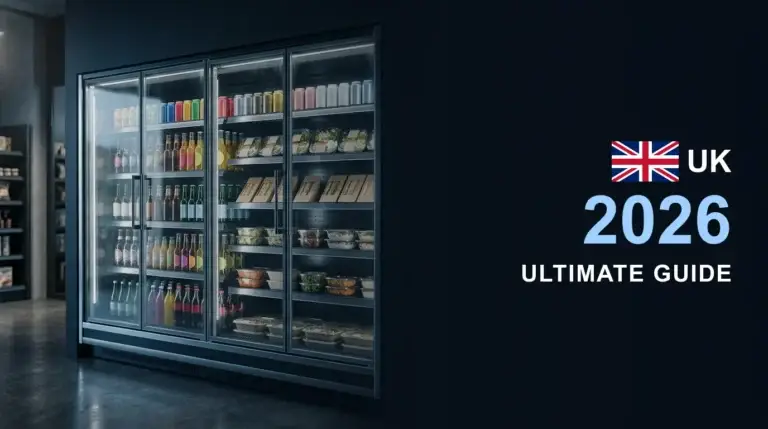
A multideck fridge is the multi-shelf chilled display unit used in supermarkets, delis, and food-to-go outlets. This guide covers the critical open-front vs glass-door energy decision — worth around £747 per year — plus every TEFCOLD model, sizing guidance, and UK compliance requirements.
- Energy comparison: TEFCOLD Galaxy+ GP10 open-front uses 10.83 kWh/day (~£1,067/year); glass door GP10FGD uses 3.25 kWh/day (~£320/year) — a saving of £747/year at 27p/kWh
- Payback on glass doors: The GP10FGD costs £342 more than the open-front GP10 — energy savings recover that premium in about six months
- UK legal temperature: The Food Safety (Temperature Control) Regulations 1995 (Schedule 4 of the 2006 Food Hygiene Regulations in England and Wales) require chilled display at 8°C or below; FSA good practice is 5°C or below for raw meat and fish. TEFCOLD Galaxy+ operates at −1°C to +5°C
- Refrigerant: R290 (GWP 3) — a natural refrigerant unaffected by the F-gas phase-down
- Range: 1.0m to 2.6m wide — from the 1.31m PC1250B compact to the 2.6m GP26FGD supermarket-grade display
- Open front vs glass doors: Glass door models use approximately 70% less energy than open-front equivalents of the same width and brand
- Manufacturer: TEFCOLD (Denmark) — CE/UKCA marked, Climate Class 3 (25°C ambient), sold and serviced in the UK by FridgeSmart
A multideck fridge is the workhorse of grab-and-go retail — the tall, multi-shelf chilled display that makes sandwiches, dairy, drinks, and fresh produce immediately visible and accessible to customers. Done wrong — particularly with an open-front unit in a warm shop — it’s one of the biggest energy bills you’ll run.
This guide covers the key decision every buyer needs to make first (open front or glass doors), how the TEFCOLD Galaxy+ range works, what the real running costs look like, and which model suits which operation — from the compact PC1250B at £1,624 to a 2m supermarket-style display at over £4,000. Browse the full multideck fridge range to compare all models.
The TEFCOLD Galaxy+ GP10 open-front multideck uses 10.83 kWh/day. The identical unit with glass doors, the GP10FGD, uses 3.25 kWh/day. Same footprint, shelves and capacity. The door version costs £342 more and saves £747 a year in electricity at 27p/kWh. That changes which unit you should order.
Less energy — glass doors vs open front, same model
Under the Food Safety (Temperature Control) Regulations 1995 (Schedule 4 of the 2006 Food Hygiene Regulations in England and Wales), all chilled food on display must be held at 8°C or below; FSA good practice is 5°C or below for raw meat and fish. Scotland has its own rules. The TEFCOLD Galaxy+ and PC multideck range operates at −1°C to +5°C — comfortably within legal limits and suitable for meat, fish, dairy, sandwiches, and produce. Open-front units in warm, draughty environments can struggle to maintain these temperatures. Your Environmental Health Officer checks the product temperature, not the air temperature — a good thermometer in the product is essential for compliance records (keep the logs for at least 12 months — good practice, not law).
Starting price for a TEFCOLD multideck with doors (ex. VAT)
Annual energy saving — glass door vs open front on the same 1m model
Net usable capacity of the Galaxy+ GP14FGD — 1.33m wide
The Big Decision: Open Front or Glass Doors?
This is the most misunderstood choice in commercial refrigeration. Open-front multidecks are not inherently better for sales — and the energy penalty is enormous. Here is the honest comparison.
Factor
Open Front
Glass Door (FGD)
Energy (1m unit)
✗ 10.83 kWh/day — ~£1,067/year
✓ 3.25 kWh/day — ~£320/year
Annual energy saving
—
✓ ~£747/year vs open front
Temperature stability
✗ Affected by draughts, AC, heat from kitchen
✓ Consistent — doors contain cold air
Customer access
✓ No door to open — fully grab-and-go
Doors open easily — minimal friction
Product visibility
✓ Fully open view, no glass reflection
✓ Frameless glass — nearly as clear
Ambient sensitivity
✗ Cannot be placed near heat sources or AC vents
✓ Much less affected by room temperature
Purchase price premium (1m)
£2,780 (GP10 White)
£3,122 (GP10FGD White) — £342 more
Payback on door premium
—
✓ About six months of energy savings
When open front is right
High-traffic supermarket with climate control; very short dwell time
—
For the vast majority of UK convenience stores, delis, cafés, and food retailers: choose the glass door version. The £342 price difference on a 1m unit is recovered in about six months of energy savings. Over a 10-year unit lifespan, doors save around £7,470 in electricity on a single 1m multideck. Open front is appropriate only in heavily climate-controlled supermarkets with constant high footfall and very short customer dwell times.
Five Types of Multideck — Which Do You Need?
Open Front
From £2,780 (GP10)
- No door — fully open
- Air curtain cools display zone
- High energy use (~11 kWh/day)
- Best: very high traffic retail
- Includes nightblind for closing
Glass Door (FGD)
From £3,122 (GP10FGD)
- Frameless hinged glass doors
- Self-closing, double-glazed
- ~70% less energy than open
- Best: most UK food retail
- Same internal capacity as open
With Shutter (MCX)
From £2,895 (MCX90M)
- Integral roll-down night shutter
- Secures product overnight
- No separate nightblind needed
- Best: 24/7 retail, petrol forecourt
- 0.9m to 2.0m wide
Wall-Site with Doors
From £2,853 (Framec)
- Designed for wall installation
- Rear remote refrigeration option
- Sliding glass doors
- Best: larger retail fit-outs
- 5 shelf display, 1.0m to 1.9m
Compact / Slimline
From £1,624 (PC1250B)
- Same 740mm depth as Galaxy+, lower price
- Glass doors, 5 shelves
- −1 to +5°C, B energy rating
- Best: small shops, cafés
- Castors for repositioning
Four Models Across the Range
All Galaxy+ models run at −1°C to +5°C and are suitable for fresh meat, dairy, sandwiches, and produce. All use R290 natural refrigerant (GWP 3), which is unaffected by the F-gas phase-down. Capital spend on plant like this can normally be set against the Annual Investment Allowance or full expensing — ask your accountant. All prices ex. VAT.
ex. VAT — RRP £3,065
Energy Rating B
- External: 1,310 × 740 × 2,050mm
- Internal volume: 764L net
- Temperature: −1 to +5°C
- 5 adjustable shelves
- Energy: 5.87 kWh/24h
- Refrigerant: R290
- Castors with locking brakes
The most affordable entry point in the range. Self-closing frameless glass doors, under-shelf LED lighting, and castors for easy repositioning. Suitable for fresh meat display (3M1 spec). Black interior and exterior with glass end walls.
ex. VAT — RRP £3,929
- External: 1,018 × 750 × 2,005mm
- Internal volume: 472L net
- Temperature: −1 to +5°C
- 5 adjustable shelves (7° or 14° angle)
- Energy: 10.83 kWh/24h
- Soft-close nightblind included
- EPOS ticket strips as standard
TEFCOLD’s flagship open-front unit. Mirrored interior end walls, horizontal LED lighting, 40mm insulated end panels. Can be multiplexed into a run of units. Best suited to high-footfall environments with climate control. Also available in Black and Stainless Steel.
ex. VAT — RRP £4,412
Energy Rating B — saves £747/yr vs GP10
- External: 1,018 × 750 × 2,005mm
- Internal volume: 472L net
- Temperature: −1 to +5°C
- 5 adjustable shelves (7° or 14° angle)
- Energy: 3.25 kWh/24h
- Frameless self-closing glass doors
- EPOS ticket strips as standard
Identical footprint and capacity to the GP10 open front — but with frameless double-glazed self-closing doors that cut energy from 10.83 to 3.25 kWh/day. £342 more to buy. The £747 annual energy saving pays back the door premium in about six months. Available in Black and Stainless too.
ex. VAT — RRP £4,988
Energy Rating B
- External: 1,330 × 750 × 2,005mm
- Internal volume: 629L net
- Temperature: −1 to +5°C
- 5 adjustable shelves (7° or 14° angle)
- Energy: 3.66 kWh/24h
- Ultra-low front, slim top canopy
- Fits through 750mm doorways
33% more display space than the GP10FGD for just £561 extra. The slim top canopy adds 100mm of internal height. At 3.66 kWh/day it runs at roughly £361/year — still a fraction of the equivalent open-front cost. Available in Black and Stainless. GP20 and GP26 widths are also available for larger runs.
Galaxy+ units are plug-in and multiplex side by side with matching end panels — each runs independently, so a run can grow one unit at a time. The GP20 (2m) and GP26 (2.6m) units are available in both open front and FGD door versions for larger convenience stores and supermarkets. See the full range →
How to Read the TEFCOLD Model Numbers
GP = Galaxy+ (Galaxy Plus — the premium multideck range)
10 / 14 / 20 / 26 = Width in decimetres: GP10 = 1.0m, GP14 = 1.4m, GP20 = 2.0m, GP26 = 2.6m
FGD = Frameless Glass Door. No FGD suffix = open front.
White / Black / SS = Finish (all same price except SS which is slightly more)
Example: GP14FGD Black = Galaxy+, 1.4m wide, frameless glass doors, black finish.
PC[width]B — compact/budget multideck range. PC1250B = 1,250mm wide, B = black.
MCX[width]M — multideck with integrated night shutter. MCX130M = 1.3m wide, M = motorised shutter.
Framec SUPER SUNNY[shelves] — wall-site models with sliding doors. 10 = 10 shelves, 14 = 14 shelves, 19 = 19 shelves.
Size Guide: Which Width Do You Need?
Model Width
Net Capacity
Shelves
Best For
Open Front Price
Glass Door Price
1.25m (PC1250B)
764L
5
Small café, sandwich shop
—
£1,624
1.0m (GP10)
472L
5
Small convenience store, deli
£2,780
£3,122 ★
1.4m (GP14)
629L
5
Convenience store, food hall
£3,231
£3,529 ★
2.0m (GP20)
943L
5
Busy convenience store, deli counter
£4,625
£4,995 ★
2.6m (GP26)
1,258L
5
Large retail, supermarket aisle
£5,886
£6,006 ★
0.9–2.0m (MCX shutter)
Varies
4–5
24/7 retail, forecourt, secure overnight
From £2,895
★ = Recommended — glass door version saves £700+ per year in energy vs the open front equivalent (GP10: £747/year at 27p/kWh).
The Real Running Cost: Open Front vs Glass Doors Over Time
£2,780
£3,122 (+£342)
£1,067/year
£320/year
£747/year
About six months (24 weeks)
£7,470
Before You Order: Four Things to Check
Galaxy+ units are 750mm deep externally (the PC1250B 740mm). You’ll need that plus 600mm of customer access in front and the rear gap given in the manual — typically 100mm for plug-in cabinets. The units are 2,005–2,050mm tall — check ceiling height and lighting fixtures. For installation through a narrow doorway, the GP14FGD is specifically noted as fitting through a 750mm door opening.
All Galaxy+ multideck units run on standard 220–240V / 50Hz single phase. The GP10FGD is rated at 289W input and averages around 135W over a day (3.25 kWh/24h). Run a dedicated circuit from a fused spur — don’t share with other high-draw appliances. For a run of three or more units, discuss the electrical load with your electrician before installation.
Open-front multidecks rely on an internal air curtain to contain cold air. Any external airflow — from an air conditioning vent blowing across the front, a frequently opened external door nearby, or radiant heat from a hot food counter — disrupts that curtain and forces the unit to work much harder. This is the single biggest cause of open-front units failing to maintain temperature in UK shops. Glass door units are far less sensitive to placement.
Galaxy+ shelves adjust to flat, 7°, or 14° angles. Angled shelves at 7° are standard for most chilled produce — products face the customer and are less likely to be pushed to the back. 14° works well for drinks bottles and cans. Flat shelves suit prepared meal trays and larger items. Set the angles before the unit is loaded — it takes 5 minutes and makes a significant difference to visibility and accessibility.
The Galaxy+ range is available in white, black, and stainless steel (SS) finishes — all at the same price except stainless which carries a small premium. White is the most common choice for general food retail environments where a clean, bright look matches the shop fit-out. Black suits a premium deli, artisan food hall, or butchery counter where the darker aesthetic adds visual weight and a high-end feel. Stainless steel is the right choice for commercial kitchen or food preparation environments where the surface needs to withstand regular deep cleaning and meets food-safe standards for exposed surfaces. All finishes share the same mirrored interior end walls.
6 Questions to Ask Before You Order
- ✓
Open front or glass doors?
Unless you’re fitting a large supermarket-style operation with full climate control and consistently very high footfall, choose glass doors. The £747/year energy saving on just one 1m unit is too significant to ignore. - ✓
What are you displaying?
All Galaxy+ units are rated −1°C to +5°C — suitable for fresh meat (3M1 spec), dairy, sandwiches, produce, and drinks. If you need a unit specifically for ambient temperature produce (fruit and veg), a non-refrigerated ambient bay or a produce-spec unit set to 8–10°C would be more appropriate. - ✓
What width run do you need?
A 1m unit holds roughly 3–4 product categories with adequate depth. A 1.4m unit is better for a convenience store wanting to display dairy, meat, and sandwiches in one run. Galaxy+ units multiplex side by side — you can buy two GP10FGD units and run them as a 2m display. - ✓
Do you need overnight security?
If the unit will be in an unstaffed area overnight (forecourt shop, 24/7 convenience), the MCX shutter range has an integral roll-down motorised shutter that secures the display after hours without needing to empty and restock. The open-front Galaxy+ includes a soft-close nightblind but this does not lock. - ✓
White, black, or stainless steel?
White and black are available at the same price across the Galaxy+ range. Stainless steel (SS) costs slightly more. White reads cleaner in a bright food retail environment; black looks more premium in a deli or food hall; SS suits a commercial kitchen or butchery context. All have mirrored interior end walls. - ✓
Will you use EPOS shelf labels?
All Galaxy+ units include EPOS ticket strips as standard — the plastic price label rails that run along each shelf front. If you’re operating a convenience store with a POS system and shelf-edge labels, these are compatible and included in the box.
Price Guide
£1,624
PC1250B — 1.25m, glass doors (ex. VAT)
£2,780
GP10 White — open, 10.83 kWh/day
£3,122
GP10FGD White — 3.25 kWh/day, saves £747/yr
£3,529
GP14FGD White — 629L, 3.66 kWh/day
All Featured Models at a Glance
Model
Width
Type
Net Vol.
Energy/Day
Annual Cost*
Ex. VAT
PC1250B
1.31m
Glass doors
764L
5.87 kWh
~£579
£1,624
GP10 White
1.02m
Open front
472L
10.83 kWh
~£1,067
£2,780
GP10FGD White ★
1.02m
Glass doors
472L
3.25 kWh
~£320
£3,122
GP14 White
1.33m
Open front
629L
16.65 kWh
~£1,641
£3,231
GP14FGD White ★
1.33m
Glass doors
629L
3.66 kWh
~£361
£3,529
GP20FGD White ★
~2.0m
Glass doors
943L
5.47 kWh
~£539
£4,995
★ = Recommended glass door version. *Annual energy cost at 27p/kWh.
37 multideck models available — open front, glass door, shutter, and wall-site. All Galaxy+ units available in white, black, and stainless steel.
Browse All Multidecks
View GP10FGD — Our Top Pick
For bakery and patisserie display, see our cake display fridge buying guide. Fitting out a convenience store? Read our convenience store refrigeration guide. To maximise energy savings across all your refrigeration, see our guide to cutting commercial fridge energy bills.
A commercial multideck fridge is a multi-shelf chilled display used in food retail, delis, convenience stores, and food-to-go outlets. The most important buying decision is open front vs glass doors: TEFCOLD Galaxy+ glass door models (e.g. GP10FGD) use 70% less energy than equivalent open-front units — saving around £747 per year on a 1m unit at 27p/kWh. The glass door premium of £342 is recovered in electricity savings in about six months. UK law (the Food Safety (Temperature Control) Regulations 1995, Schedule 4 of the 2006 Food Hygiene Regulations in England and Wales) requires chilled display food to be held at 8°C or below. For the vast majority of UK food businesses, a glass door multideck is the correct choice. The TEFCOLD Galaxy+ range — stocked by FridgeSmart — spans 1.0m to 2.6m and uses R290 refrigerant (GWP 3).
Frequently Asked Questions
▼
▼
▼
▼
▼
▼