Last reviewed: October 2026 · Lisa Craven, Managing Director, FridgeSmart
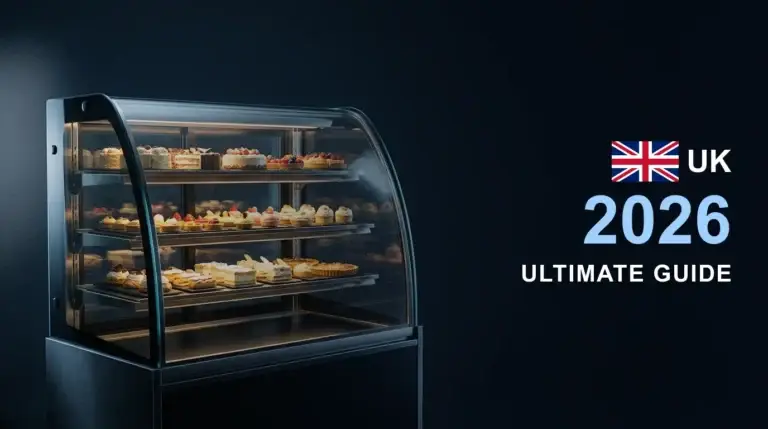
A cake display fridge keeps cream cakes, pastries, and desserts at the legally required temperature (below 8°C under UK food hygiene law) while presenting them to maximise impulse purchases. This guide covers countertop, floor-standing, and premium patisserie serve-over options — with the 5-year running cost comparison that proves cheaper isn’t always cheaper.
Key Facts: Cake Display Fridges (UK, 2026)
- Legal temperature: Under UK temperature-control law (the 8°C chill-holding rule) and HACCP duties under retained Regulation (EC) 852/2004, cream-filled patisserie must be stored and displayed at 8°C or below — display cases must maintain this throughout service hours
- Humidity: Cake display fridges use low-fan, high-humidity airflow to prevent product drying out — standard commercial refrigerators use aggressive airflow that dries out exposed pastry and cream
- Glass types: Curved glass (panoramic, higher visual impact) vs straight glass (easier cleaning, lower cost); heated glass front panels prevent condensation in high-humidity environments
- Lighting: LED interior lighting is critical for patisserie display — warm white LEDs (3000K) flatter food better than cool white; all the TEFCOLD cake displays in this guide have interior lighting as standard
- Energy: TEFCOLD LPD range (cake display) — LPD1500C uses 13.53 kWh/day (~£1,433/year at 29p/kWh UK commercial rate 2026)
- Shelf configuration: Typically 2–4 adjustable shelves plus the base deck (glass on the LPD and EVO, wire on the UPD countertops) — check the product page for shelf count and finish
- Supplier: TEFCOLD LPD and Tefcold display range — stocked and delivered UK-wide by FridgeSmart
Cake Display Fridge Guide 2026
The “cheap” cabinet costs £1,332 a year to run.
The premium one costs just £847.
A basic £1,029 floor-standing display draws 12.58 kWh every 24 hours. The £2,201 patisserie serve-over — more than double the price — draws just 7.99 kWh. Over five years it saves £2,425 in electricity — £1,267 more than the extra purchase price. This guide explains why, and how to pick the right type for your business.
✓ 7 models compared
✓ Real prices & specs
✓ 4 display types explained
✓ Temperature guide by food type
A well-chosen cake display fridge does two jobs at once: it keeps your patisserie, cream cakes, and desserts at a safe temperature (below 8°C under UK food hygiene law), and it sells for you — presenting your products in their best light to customers who haven’t yet decided whether to buy.
The market splits into four very different types of cabinet, running costs vary by 57%, and the “right” choice depends entirely on how your business operates. Here’s everything you need to know.
The 4 Types of Cake Display Fridge
🍰
Countertop Display
From £362
Compact units (60–80L) that sit on a worktop or counter. Ideal for cafés with limited floor space. Models:
UPD60,
UPD80.
🏪
Floor-Standing Display
From £991
Full-height refrigerated cabinets (900–1,700mm wide) with staff access from rear sliding doors. Models:
LPD900C,
LPD1200C, LPD1500C.
🎂
Patisserie Serve-Over
From £1,474
Premium cabinets with individually illuminated glass shelves and hinged front glass. Staff serve customers over the top. Models:
EVO602 to
EVO1802.
🗼
Tower / Column Display
From £2,001
Tall, narrow cabinets (600–700mm wide, up to 2m tall) with a small footprint and maximum visual impact. Models: Framec VENERE range.
Not sure which type you need? Jump to the
Quick Decision Guide at the bottom — answer three questions to find your match.
What Temperature Does Each Product Need?
This is where many buyers go wrong. Not everything in a cake display needs to be at 2°C — some products dry out or lose texture if they’re kept too cold. UK food law (the 8°C chill-holding rule in the Food Safety and Hygiene (England) Regulations 2013 and the Food Safety (Temperature Control) Regulations 1995 in Wales, with HACCP duties under retained Regulation (EC) 852/2004) requires chilled foods containing cream, custard, or similar fillings to be kept at or below 8°C. Here’s the sweet spot for each product type:
Fresh cream cakes, gâteaux, mousse cakes
High-risk dairy — legally must be below 8°C. Best presented cold but not frozen
1–4°C
Eclairs, profiteroles, custard pastries
Choux pastry softens if too warm — keep cool but not icy
2–5°C
Cheesecake, tarts with cream filling
Needs chilling but benefits from a few minutes at room temperature before serving
2–6°C
Macarons, meringues with cream
Shells can absorb moisture at higher temps — keep relatively cool and dry
4–8°C
Celebration cakes with buttercream
Buttercream sets very firm when too cold — display at the warmer end of the range
6–8°C
Muffins, brownies, traybakes (no cream)
No chilling required by law — ambient is fine, but chilling extends shelf life
Ambient–8°C
Sandwiches, wraps, filled rolls
UK food law: must be at or below 8°C. FSA recommends 5°C best practice
1–5°C
Mixed-product displays: If you’re displaying cream cakes alongside ambient items, the whole cabinet must comply with the strictest product requirement. Set to 2–5°C and accept that your ambient products will simply be stored cool — this is legal and safer.
The 5-Year Ownership Cost: Why “Cheap” Isn’t Cheap
Running at 29p/kWh (UK commercial average, 2026), the energy gap between display types is significant. Comparing two models at similar widths — the LPD1200C floor-standing display (£1,029) and the EVO1202 patisserie serve-over (£2,201):
Energy use12.58 kWh/day
Annual running cost£1,332/year
5-year running cost£6,660
5-year total (buy + run)£7,632
Energy use7.99 kWh/day
Annual running cost£847/year
5-year running cost£4,235
5-year total (buy + run)£6,365
The EVO1202 is cheaper to own over 5 years — by £1,267.
Despite costing £1,158 more to buy, it uses 37% less energy than the
LPD1200C. The extra spend pays back in under 2.5 years, and you end up with a premium serve-over patisserie display with individually illuminated glass shelves — not a basic cabinet. The EVO1202 is the better financial decision if you plan to use it for more than two and a half years.
7-Model Comparison Table
| Model |
Type |
Price (ex VAT) |
Width |
Capacity |
Temp Range |
Energy/Day |
Run Cost/Year |
|
Entry Level
|
Countertop |
£362 |
428 mm |
60 L |
+2 to +12°C |
3.59 kWh |
£381 |
|
More Shelves
|
Countertop |
£408 |
428 mm |
80 L |
+2 to +12°C |
3.75 kWh |
£397 |
|
Best Budget Floor
|
Floor-Standing |
£991 |
905 mm |
158 L net |
+2 to +8°C |
10.97 kWh |
£1,162 |
|
Popular Choice
|
Floor-Standing |
£1,029 |
1,205 mm |
218 L net |
+2 to +8°C |
12.58 kWh |
£1,332 |
|
Wider Floor Unit
|
Floor-Standing |
£1,532 |
1,500 mm |
277 L net |
+2 to +8°C |
13.53 kWh |
£1,433 |
|
Premium Pick
|
Patisserie Serve-Over |
£2,201 |
1,200 mm |
440 L |
+1 to +10°C |
7.99 kWh |
£847 |
|
Larger Version
|
Patisserie Serve-Over |
£2,421 |
1,500 mm |
740 L |
+1 to +10°C |
11.4 kWh |
£1,208 |
All prices ex VAT. Running costs calculated at 29p/kWh (UK commercial average 2026). Click any model name to view on FridgeSmart.
Cracking the Model Numbers
🔍 TEFCOLD Model Number Decoder
UPD60 / UPD80
Countertop display. Number = gross volume in litres (60L or 80L) — same 428mm width, the UPD80 is the taller of the two. R600a refrigerant. Black interior, wire shelves.
LPD900C / LPD1200C
Floor-standing chilled display with rear sliding doors. Number = width in mm (900, 1200, 1500, 1700). C = curved front glass. R290 refrigerant.
EVO602 / EVO902 / EVO1202
Patisserie serve-over with four individually lit tiers and hinged front glass. Number = width in mm (602 = 600mm, 1202 = 1200mm). Add SS suffix for stainless steel version.
EVOK902 / EVOK1202
A second EVO-family patisserie range with the same four-tier illuminated layout and rear sliding doors — check the product page for how it differs from the EVO before choosing.
LPD900F / LPD1200F
F = flat (straight) front glass version of the same cabinet — lower profile, slightly less display area and lower energy use than the curved C (LPD900F 9.59 kWh/day vs LPD900C 10.97).
VENERE PS / NS / NV
Framec tower display. The PS, NS and NV suffixes denote the cooling system and temperature mode — check the product page for which variant is chilled, frozen or switchable.
8 Features That Matter in a Cake Display Fridge
🪟
Anti-Mist Front Glass
Heated front panels prevent condensation on the display glass — essential in UK kitchens where humidity fluctuates. Standard on the LPD floor-standing range. Without it, your display fogs up every time a customer opens it.
💡
LED-Illuminated Glass Shelves
The EVO range features individually lit glass shelves — light shines through each tier, not just from the top. Product on every tier is lit, not just the top shelf.
🌿
R290 Refrigerant
All LPD and EVO units use R290 (propane) — a natural refrigerant with a GWP of just 3. Outside the scope of the GB F-gas regime (assimilated Regulation (EU) 517/2014), so no phase-down or service-gas risk. The smaller UPD countertop units use R600a (isobutane), which is equally eco-friendly at GWP of 3.
🚪
Rear Sliding Access Doors
Floor-standing units need to allow staff to load and serve from the rear. The LPD range has double-glazed sliding glass rear doors — look for smooth-running doors with good seals. Poor seals waste energy and allow warm air ingress.
🌡️
Digital Temperature Controller
A digital readout lets you monitor the cabinet temperature at a glance — important for HACCP compliance. All TEFCOLD models include an electronic controller with digital display as standard.
🔇
Noise Level
The UPD countertop units run at a quiet 42 dB(A). The LPD900C is rated at 58 dB(A) — audible in a quiet café setting. If noise matters, compare the dB(A) figure on each spec sheet before you choose.
🧹
Adjustable Shelves
Adjustable glass shelves let you accommodate tall celebration cakes or tiered displays. The EVO1202’s 4 tiers can be reconfigured. Fixed-shelf units are cheaper but will frustrate you the moment you need to display something tall.
⚡
Climate Class Rating
Climate Class 3 (up to 25°C ambient) covers most UK kitchen environments. Climate Class 4 (up to 30°C) is safer if your shop gets warm in summer. The UPD countertop units are Class 4 — better for warm café frontages. LPD range is Class 3.
Countertop vs Floor-Standing: Which Do You Need?
The biggest decision for most buyers is whether to go countertop or floor-standing. Here’s the honest breakdown:
-
1
How much product do you display at once? If you stock 10–20 individual cake slices or pastries, a UPD80 at £408 is sufficient. If you’re running a full bakery counter with 15–30+ items and whole cakes on display, you need the LPD1200C or EVO1202.
-
2
Do staff serve customers, or do customers self-serve? If you’re a patisserie or café where a member of staff selects and plates products, a serve-over style (EVO range) is the right choice — customers browse from the front, staff serve from behind. If you’re a self-serve deli, the floor-standing LPD with rear doors works better.
-
3
How much counter or floor space do you have? The UPD60 is just 428mm wide — it fits on any counter. The LPD1200C takes up 1,205mm of floor space plus the depth of staff access at the rear. Measure before you order.
-
4
What’s your budget for ongoing running costs? If you’re cost-conscious long-term, the EVO1202 wins despite its higher purchase price. If you genuinely won’t keep it more than 2 years, the LPD1200C makes more sense financially.
-
5
Does it need to fit through a narrow doorway? Check the packed dimensions on the product page against your door and corridor widths — the LPD900C ships boxed at 960mm wide and 1,480mm tall, and the wider cabinets more. If access is tight, ask before you order.
💡 Pro tip: The BELLINI TOWER range is NOT refrigerated. This catches buyers out regularly. The TEFCOLD BELLINI TOWER 510, 850, and 1250 are ambient (non-chilled) cake display stands — suitable for displaying ambient products only (meringues, macarons without cream, decorated dry cakes). If you need chilled display, choose the
EVO,
LPD, or
UPD range instead.
Food Safety & Legal Requirements
UK law (Food Safety and Hygiene (England) Regulations 2013; Food Safety (Temperature Control) Regulations 1995 in Wales; HACCP under retained Regulation (EC) 852/2004): Any food that is “likely to support the growth of pathogenic microorganisms” must be stored at or below 8°C. For cream cakes, custard pastries, cheesecakes, and similar products, chilled display is not optional — it’s a legal requirement. See the
FSA chilling guidance for food businesses.
In practice, for FSA HACCP guidance compliance, you should:
-
✓
Record daily cabinet temperatures as part of your temperature log — most local authority inspectors will ask to see this. A digital controller makes this easy: simply note the displayed reading at the same time each day, and keep the records for at least 12 months — good practice rather than a legal minimum.
-
✓
Don’t overfill the display. Packing shelves too tightly restricts airflow and creates warm spots. Leave space between products — especially on the top shelf where cooling airflow is often weakest.
-
✓
Allow defrost cycles to complete. All these units have automatic defrost. During a defrost cycle (usually 15–30 minutes), the cabinet temperature may briefly rise. Don’t adjust the thermostat upward in response — this is normal.
-
✓
Check door seals regularly. A failing door seal on an LPD floor-standing unit can add 15–20% to your running costs and create warm zones in the display. Press a sheet of paper against the seal with the door closed — if you can pull it out easily, the seal needs replacing.
-
✓
Don’t place hot product directly into the display. Fresh-baked items must cool to room temperature (FSA guidance: within 90 minutes) before going into the display — warm product raises the cabinet temperature and pushes neighbouring chilled items above 8°C.
Quick Decision Guide
Answer three questions to find your match:
Q1: Where will it go?
Q2: Do you have cream cakes, custard pastries, or filled products?
- Yes → Any refrigerated unit above. Set to 2–5°C. Required by law.
- No (ambient only) → A BELLINI TOWER ambient display (from £1,264) is cheaper and simpler.
Q3: Will you keep it for more than 2.5 years?
- Yes → Buy the EVO1202 (£2,201). Cheaper over 5 years than the LPD1200C due to energy savings.
- No / short-term / seasonal → LPD1200C (£1,029) makes more financial sense.
Keeping It Running: Simple Maintenance
-
1
Clean condenser coils every three months — more often in dusty or greasy environments. Dust and grease build-up on the condenser (usually at the back or bottom of the unit) forces the compressor to work harder, increasing energy use by up to 25% and shortening the compressor’s life. A soft brush and vacuum is sufficient.
-
2
Clean glass shelves weekly. Food residue on the illuminated glass shelves of the EVO range reduces the effectiveness of the internal LED lighting. Clean with a food-safe glass cleaner and a lint-free cloth — never abrasive pads which scratch the glass.
-
3
Defrost drain check monthly. The automatic defrost system melts ice and channels the water to a drain tray. If the tray or drain becomes blocked, water can pool inside the cabinet. Check and clear the drain point monthly.
-
4
Check door gaskets quarterly. The rubber seals around cabinet doors are the most common wear point. A worn gasket raises running costs and risks temperature compliance. Replacement gaskets are available from TEFCOLD distributors and are a 10-minute fix.
-
5
Allow the rear clearance given in the manual — typically 100mm for plug-in cabinets. All refrigerated cabinets need airflow around the condenser to work efficiently. Pushing the unit flush against a wall restricts this and causes overheating.
In Summary
A cake display fridge is a specialist refrigerated display cabinet designed for patisserie, cream cakes, sandwiches, and chilled prepared food. Unlike standard commercial refrigerators, cake display units use low-velocity, high-humidity airflow to prevent drying out exposed products. UK temperature-control law requires cream-filled products to be held at 8°C or below during display, with HACCP duties under retained Regulation (EC) 852/2004. TEFCOLD’s LPD range — stocked by FridgeSmart — comes in curved (C) and flat (F) glass versions, with LED lighting under each shelf, anti-mist front glass and rear sliding doors. The LPD1500C (1.5m wide) uses 13.53 kWh/day at a running cost of approximately £1,433/year at UK commercial electricity rates (29p/kWh, 2026).
Frequently Asked Questions
What temperature should a cake display fridge be set to?
▼
For cream cakes, custard pastries, cheesecakes, and other dairy-filled products, UK food hygiene law (the 8°C chill-holding rule — Food Safety and Hygiene (England) Regulations 2013; Food Safety (Temperature Control) Regulations 1995 in Wales) requires storage at or below 8°C. In practice, most environmental health officers expect to see settings of 2–5°C for high-risk chilled products. For products like buttercream cakes that become very firm when cold, you can run slightly warmer (6–8°C) but must stay within the legal limit. Always set to the coldest temperature that doesn’t compromise product quality — and log the reading daily for HACCP records.
Can I put a wedding cake or celebration cake in a cake display fridge?
▼
It depends on the decoration and filling. A cake with buttercream, fondant icing, or marzipan can technically be stored chilled, but the fondant can sweat when it comes back to room temperature (known as “sweating” condensation). Fresh cream or custard-filled celebration cakes legally require refrigeration. If you need to display whole celebration cakes, the EVO1202 is the best suited of the models here — remove a shelf and check the internal clearance on the spec sheet against your cake height before ordering.
What’s the difference between the EVO and EVO SS models?
▼
The SS suffix stands for Stainless Steel. The EVO1202 SS (£2,405 vs £2,201 for the standard) features a stainless steel exterior finish instead of the standard white. Stainless steel is easier to wipe clean in a busy bakery environment and looks more premium in a patisserie setting. The refrigeration specs, energy use, and internal dimensions are identical between the two versions. Same refrigeration spec; the £109 buys the finish only.
Is the TEFCOLD BELLINI TOWER refrigerated?
▼
No. The BELLINI TOWER 510, 850, and 1250 are ambient (non-refrigerated) cake display stands. They have no compressor, no refrigerant, and no chilling capability. They’re designed for displaying ambient-temperature products: iced biscuits, meringues, macarons (without cream filling), decorative cakes, or non-perishable items. If you put cream cakes or custard pastries in a BELLINI TOWER, you will be breaking UK food hygiene law. For chilled display, choose from the EVO, LPD, or UPD ranges.
My glass is fogging up — is something wrong?
▼
Light condensation on the outside of the glass is normal when ambient humidity is high — this is why the LPD range features anti-mist glass (a very slight heating element within the front panel). If the anti-mist glass is fogging, check: (1) the mains power supply is properly connected and the anti-mist circuit is receiving power; (2) the door seals are intact and the doors are closing fully; (3) the cabinet isn’t being opened excessively or left open. Heavy internal icing (on the evaporator) usually indicates a defrost issue — contact TEFCOLD service.
How long does a cake display fridge last?
▼
A well-maintained TEFCOLD cake display fridge should last 8–12 years in a commercial environment. The most common failure points are: door gaskets (typically replaced every 3–5 years), compressor (usually lasts 8–12 years), and LED lighting strips (typically 5–7 years in continuous operation). The R290 refrigerant used in the LPD and EVO ranges is a flammable hydrocarbon, not an F-gas, so no F-gas certificate is needed — but servicing must be done by an engineer trained on hydrocarbon systems. Ask your service contractor to confirm this before you book.
Can these units link together end-to-end for a longer counter run?
▼
Yes, the EVO serve-over range is designed to be placed side by side to create a continuous patisserie counter run. The EVO602, EVO902, EVO1202, EVO1502, and EVO1802 can all be butted together, and their matching height and depth means they align in a run — check the spec-sheet dimensions before ordering. Each unit has its own independent refrigeration system, so a failure in one won’t affect the others. The LPD floor-standing range can also be placed side-by-side, but each unit is self-contained and will have a small visual gap between them.
Do I need a dedicated 3-phase supply?
▼
No. All units in the UPD, LPD, and EVO ranges operate on standard single-phase 220–240V / 50Hz — a normal UK 13-amp socket. Input power is modest — the LPD900C is rated at 598W and the UPD60 at 164W; check the EVO spec sheet for its figure. If you’re running multiple units in a row, plan the circuit load with your electrician. Always have a qualified electrician sign off on the installation if you’re running more than two large units from a single circuit.
For serve-over counters combining display with customer service, see our serve over counter buying guide.
To keep running costs down, read our guide to cutting commercial fridge energy bills.
Browse Cake Display Fridges at FridgeSmart
Models available from £362 countertop units to full patisserie serve-over displays. All prices ex VAT, free delivery available.
View All Cake Display Fridges →