Commercial Bottle Cooler Buying Guide: The Complete UK Guide (2026)
- Lisa Craven
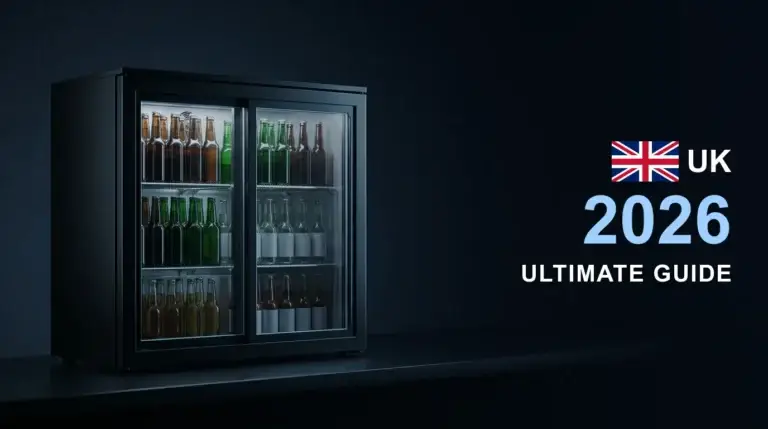
Last reviewed: October 2026 · Lisa Craven, Managing Director, FridgeSmart
A commercial bottle cooler — also called a back bar fridge — keeps bottled beer, wine, and soft drinks at ideal serving temperature (3–5°C) while displaying them for impulse sales. This guide covers undercounter vs upright, hinged vs sliding doors, and four TEFCOLD-group models with real running costs.
- Operating temperature: Commercial bottle coolers typically maintain +2°C to +10°C — covering lager at 3–5°C, soft drinks at 4–6°C and ale at the warmer end
- Glass door vs solid door: Glass door bottle coolers are used for front-of-house display and impulse purchase; solid door models are back-of-house storage only
- Upright vs undercounter: Upright bottle coolers (up to around 1,900mm tall) offer more capacity and display; undercounter models fit beneath bar counters and save floor space
- TEFCOLD DB range: Undercounter back bar coolers, 870mm tall, locks as standard — DB126H (115L net, 600mm, one hinged door), DB201S (182L net, 900mm, two sliding doors), DB301S-3 (278L net, 1,350mm, three sliding doors) — operating at +2°C to +10°C
- TEFCOLD BA range: The updated BA back bar coolers — BA21S (two sliding doors) and BA21H (hinged), 900mm wide, 188L net, 276 × 330ml cans, Energy Class A at 1.14 kWh/day
- Maintenance: Clean condenser coils every three months (more often in dusty or greasy environments); check door seals monthly; defrost manually if ice build-up is noticed
- Supplier: TEFCOLD bottle coolers — full range stocked and delivered UK-wide by FridgeSmart
A commercial bottle cooler — also called a back bar fridge or back bar cooler — is the refrigeration unit that sits behind your bar, holding canned lager, bottled beer, soft drinks, mixers, and white wine at serving temperature. It is arguably the most used piece of equipment in a pub, bar, or restaurant: opened dozens of times per service, expected to recover quickly, and visible to every customer who looks over the bar.
This guide covers everything you need to choose the right model: which door type suits your bar layout, whether to go undercounter or full upright, how to calculate capacity for your volume, and a complete breakdown of four key models from TEFCOLD and Elstar — from a 115L single bar fridge at £331 to a full-height 307L display unit at £651. All prices exclude VAT. The FSA guidance on chilling drinks and food sets no temperature for bottled drinks — the 8°C chill-holding rule applies to perishable food, which is why these units should not double as food fridges (see the FAQ).
The temperatures below are quality and flavour recommendations, not legal requirements. All bottle coolers on this page operate within +2 to +10°C — the ideal commercial range for cold drinks service. Lager / Pilsner: serve at 3–5°C, store at 2–4°C. Ale / Stout: serve at 8–12°C (slightly warmer brings out character). Soft drinks & mixers: 4–6°C. White wine: 7–10°C. Energy drinks: 4–8°C. Premium spirits are not typically chilled — room temperature.
Undercounter or Upright? The First Decision
Back bar coolers come in two fundamental formats. The choice is about height, visibility, and how much space is behind your bar. Get this wrong and you either block sightlines customers expect or waste expensive upright real estate on a unit that didn’t need to be full height.
870mm tall — fits beneath bar top
- Hidden from customers, accessible to bar staff
- Sits within standard bar counter height
- Up to 278L capacity (DB301S-3)
- Works as a continuous run with ice well and till
- Sliding doors use no swing clearance behind bar
- Hinged doors need roughly their own width (about 600mm) to swing open
- Best for: pub bars, hotel bars, restaurant service stations
1,872mm tall — full height display
- Visible to customers — acts as display and storage
- Glass front door merchandises the product
- 307L+ in a single 600mm-wide footprint
- Single glass door — check hinge side against your layout
- Ideal for craft beer, premium bottles, wine by the glass
- Slightly higher energy use due to larger volume
- Best for: front-of-house bars, craft beer venues, display bars
Hinged or Sliding Doors?
For undercounter models, you also choose the door mechanism. This is almost always decided by bar layout — specifically how much clearance exists behind the bar. Getting it wrong means either a door that can’t open fully or an unnecessarily cramped workspace.
Full open access — DB-H suffix models
- Door opens fully, best for fast bottle retrieval
- Full interior visibility when open
- Needs roughly a door’s width (about 600mm) of clearance to open fully
- Standard in bars with wider service aisles
- Slightly simpler mechanics — fewer moving parts
- Single or double door options
- DB126H is the TEFCOLD hinged entry-level model
No swing clearance — DB-S suffix models
- Zero swing clearance needed — ideal for tight bar runs
- Can access from both sides of the unit
- Multiple sliding panels across wider models
- Better for high-traffic service with multiple staff
- DB201S has 2 sliding doors across 900mm
- DB301S-3 has triple sliding panels across 1,350mm
- Best for: busy pub bars, narrow service aisles, long bar runs
Stand behind your bar and fully extend your arm sideways — if you hit the wall or another unit within 600mm, choose sliding doors. The TEFCOLD DB-S range (DB201S, DB301S-3) is specifically designed for narrow bar configurations where a hinged door would swing into another fridge, the ice well, or a colleague. The DB-H models are the better choice when fast single-hand retrieval matters more than clearance.
Four Models Across the Range
From a 115L solo bar fridge at £331 to a full-height 307L display unit at £651. All models operate at +2 to +10°C on a standard 13-amp supply and include double-glazed glass doors to minimise temperature loss between openings. All prices exclude VAT.
ex. VAT — RRP £589
- Capacity: 115L net / 113 × 330ml cans
- 112 × 330ml bottles / 84 × 500ml cans
- External: 600 × 545 × 870mm
- Temperature: +2 to +10°C
- Doors: Hinged double-glazed glass
- Cooling: Ventilated, auto defrost
- Energy: 0.96 kWh/24h (350 kWh/year)
- EEI: 9%
The entry point into commercial back bar cooling. At 600mm wide it replaces a single undercounter unit without changing the bar footprint. The hinged door gives full-width access and the ventilated cooling system recovers quickly after high-traffic openings. Best for a solo operator, small café, or as a supplementary fridge in a larger bar.
ex. VAT — RRP £790
- Capacity: 190L gross (182L net) / 209 × 330ml cans
- 132 × 500ml cans / 192 × 330ml bottles
- External: 900 × 550 × 870mm
- Temperature: +2 to +10°C
- Doors: 2 sliding double-glazed doors
- Cooling: Ventilated, fast pull-down
- Energy: 1.14 kWh/24h (416 kWh/year)
- EEI: 9%
The most popular format for UK pub and restaurant bars. At 900mm wide with two sliding doors, bar staff can reach either half of the unit without disturbing the other — useful during a busy service. Fast pull-down cooling restores temperature quickly after a high-frequency rush. At just £112/year in running costs this is one of the most efficient purchases behind any bar.
ex. VAT — RRP £1,027
- Capacity: 278L net / 380 × 330ml cans
- 266 × 500ml cans / 218 × 330ml bottles
- External: 1,350 × 526 × 870mm
- Temperature: +2 to +10°C
- Doors: Triple sliding double-glazed glass
- Cooling: Ventilated, auto defrost, security lock
- Energy: 1.74 kWh/24h (635 kWh/year)
- EEI: 12%
The high-volume undercounter option — 1,350mm of bar run holding 380 cans behind triple sliding panels. The security lock is a practical addition for venues that need to restrict access outside service hours. Auto defrost keeps maintenance hands-off. If your bar goes through 200+ drinks per service, this is the undercounter unit that keeps up.
ex. VAT — RRP £920
- Capacity: 307L gross
- External: 600 × 520 × 1,872mm
- Temperature: +2 to +8°C
- Doors: Single hinged glass (not reversible)
- Cooling: Fan-assisted, auto defrost
- Energy: 2.04 kWh/24h (745 kWh/year)
- Refrigerant: R600a
- Noise: 56 dB(A)
At 1,872mm tall, the EM300 is a front-of-house display unit as much as a storage fridge. The full-height glass door lets customers see the product — effective for premium bottled beers, craft ales, cocktail mixers, and chilled wine by the glass. The door is not reversible, so check which way it opens against where it will sit in the run. R600a refrigerant for lower environmental impact.
The four models above are highlighted picks — FridgeSmart stocks a wider selection of back bar coolers and bottle fridges including the TEFCOLD BA21S, Elstar EM500, Serrco SGD-240GE premium back bar, and more. View all bar fridges and back bar coolers → | Bottle coolers sub-category →
Which Model for Your Operation?
Use this table as a starting point based on the type and volume of your operation. Actual capacity needs depend on how many drinks you turn over per service, your delivery frequency, and how much back stock you store elsewhere.
| Operation Type | Typical Daily Volume | Recommended Model | Why |
|---|---|---|---|
| Small café / deli | Up to 50 drinks/day | TEFCOLD DB126H | 115L / 113 cans, fits in tight counter space, hinged door for easy single-hand access |
| Village pub / neighbourhood bar | 50–150 drinks/day | TEFCOLD DB201S | 190L / 209 cans, sliding doors suit a typical 900mm bar bay, fast pull-down cooling |
| Busy pub / restaurant bar | 150–300 drinks/day | TEFCOLD DB301S-3 | 278L / 380 cans, triple sliding panels, security lock, handles a full evening service |
| Craft beer / premium display bar | Any volume | Elstar EM300 | 307L upright with glass door — merchandise product to customers, lockable |
| High-volume venue / nightclub | 300+ drinks/day | DB301S-3 + Elstar EM300 | Combine undercounter volume with upright display — full coverage front and back of bar |
| Hotel room service / minibar top-up | Variable, low peak | TEFCOLD DB126H | Compact, quiet, low running cost — ideal for back-of-house prep station |
How to Read TEFCOLD Model Numbers
126 / 201 / 301 = Approximate gross volume in litres (115L, 182L, 278L net respectively)
H = Hinged door(s) — requires swing clearance behind bar
S = Sliding door(s) — no swing clearance required
S-3 = Three sliding panels across the unit (DB301S-3)
BA = The updated BA back bar range — BA21S (two sliding doors), BA21H (hinged), 900mm wide
EM = Elstar’s upright full-height back bar display range (EM300, EM500)
Serrco SGD = Serrco by TEFCOLD premium back bar range, anthracite finish — GE suffix = hinged glass doors, E = solid doors
Before You Order: Four Things to Sort
The TEFCOLD DB undercounter models sit at 870mm tall (the BA21S is 900mm) — the standard height to fit beneath a bar top. The width varies: DB126H is 600mm, DB201S is 900mm, DB301S-3 is 1,350mm. The Elstar EM300 is 1,872mm tall and needs clearance above. Measure the exact bay width and ceiling height before ordering. Most bars are built on a 600mm module — the DB126H and EM300 share that footprint exactly.
Stand behind your bar and measure the clear width between the front of the unit and the wall or back of bar behind you. If you have less than 600mm of clear aisle, choose a sliding door model (DB201S or DB301S-3). The sliding mechanism adds zero swing space and lets multiple staff access different sections of the unit simultaneously during busy service. For wider aisles where speed of single-hand retrieval matters, the DB126H hinged model is faster to use in practice.
Use this rule: your minimum chiller capacity (in cans equivalent) should be 1.5x your busiest single-day throughput. If you sell 200 cans on a Saturday, you need at least 300-can capacity to avoid running warm stock into service. The DB201S holds 209 × 330ml cans — enough for a bar selling up to about 140 cans on its busiest day. Above that, or if you run two or three separate products (lager, craft, soft drinks), consider multiple units or the larger DB301S-3 at 380 cans.
All ventilated-cooling back bar coolers need clear airflow around the unit — the gap given in the manual, typically 100mm at the rear and top. Do not box them in tightly without ventilation gaps. In hot kitchens or enclosed spaces where ambient temperatures regularly exceed 25°C, performance at the lower end of the temperature range (+2 to +4°C for lager) will be reduced. For front-of-house bars in air-conditioned rooms this is not a concern. The Elstar EM300 is quoted in the mid-50s dB(A) — about normal conversation level — so it is suitable for dining areas and hotel lobbies; check the figure on the spec sheet if noise is critical.
6 Questions to Ask Before You Order
-
✓
Does your bar run use 600mm or 900mm bays?
Most commercial bar runs are designed on a 600mm modular grid. The DB126H and Elstar EM300 fit exactly. The DB201S (900mm) and DB301S-3 (1,350mm) are non-standard widths — measure and confirm the available bay before ordering to avoid installation issues. -
✓
Is the unit visible to customers?
If yes, the Elstar EM300‘s full-height glass door is a sales tool as much as a fridge. Customers can see what’s chilled and available — which directly influences impulse purchases of premium bottled beers and chilled wine. For back-of-bar-only placements where customers cannot see the unit, an undercounter sliding model is the practical choice. -
✓
What is your peak hourly throughput?
A busy Friday night bar might open the back bar fridge 60–80 times in an hour. Models with ventilated cooling and fast pull-down (DB201S) are specified for this kind of use. The temperature recovery speed after door opening is a more important spec than maximum stated capacity for high-frequency service. -
✓
Do you need a security lock?
The DB301S-3 includes a security lock as standard — as do the DB126H, DB201S, BA21S and Elstar EM300. Useful anywhere you want to stop stock walking after hours. Check the product page if you are looking at a model outside this guide. -
✓
Are you replacing an existing unit on a narrow connection?
All models in this range run on a standard 13-amp UK socket — no specialist electrical connection needed. The Elstar EM300 uses R600a refrigerant. No plumbing is required for any of these models. Check that the existing socket position and power lead length work for the new placement before delivery day. -
✓
What drinks will you actually store in it?
Back bar coolers are optimised for bottles and cans, not food. Lager, bottled ale, soft drinks, mixers, and white wine are all ideal. Do not use a back bar cooler as a food storage unit — its +2 to +10°C range can run above the 8°C legal limit for chilled food, and these units are not designed or monitored for food-safe storage. Keep food refrigeration separate.
What Does a Commercial Bottle Cooler Cost to Buy and Run?
Back bar coolers are low-energy appliances relative to their commercial workload. Running at modest temperatures (+2–10°C) and using ventilated fan-assisted cooling, the annual electricity cost for the DB and EM models is in the range of £95–£200/year at 27p/kWh. (The Energy Saving Trust covers domestic appliances only — use the kWh/day on each product page for commercial units.)
£559 ex. VAT
£112/year to run
Just 30.8p/day
~£4.50 per bottle
£4.50 lost per incident
104 extra bottles
Full Range Comparison
| Model | Type | Capacity | Door | Width | Energy/Day | Ex. VAT |
|---|---|---|---|---|---|---|
| TEFCOLD DB126H | Undercounter | 115L / 113 cans | Hinged | 600mm | 0.96 kWh | £331 |
| TEFCOLD BA21S | Undercounter | See product page | 2 × Sliding | See product page | See product page | £581 |
| TEFCOLD DB201S ★ | Undercounter | 190L / 209 cans | 2 × Sliding | 900mm | 1.14 kWh | £559 |
| TEFCOLD DB301S-3 | Undercounter | 278L / 380 cans | 3 × Sliding | 1,350mm | 1.74 kWh | £577 |
| Elstar EM300 | Upright | 307L gross | Single Hinged | 600mm | 2.04 kWh | £651 |
| Elstar EM500 | Upright | See product page | Single Hinged | See product page | See product page | £927 |
| Serrco SGD-240GE | Premium Back Bar | 260L / 386 cans | 2 × Hinged glass | 1,110mm | 7.06 kWh | £1,661 |
★ = Best-seller for busy UK bar environments. Serrco SGD-240GE is a premium anthracite-finish bottle and keg cooler (Energy Class F, 7.06 kWh/day — about £696/year at 27p) — suited to high-end bar fitouts where looks outweigh running cost.
From a £331 solo bar fridge to a 380-can triple-door unit — all TEFCOLD-group — and the DB and EM models run on less than the cost of a pint of lager per week in electricity.
Browse All Back Bar Coolers
View the DB201S
Keeping Your Back Bar Cooler Running: Maintenance Essentials
A commercial back bar fridge is open dozens of times per service. Basic maintenance prevents temperature drift, reduces energy use, and extends unit lifespan. None of these steps require specialist knowledge.
Dust and grease build up on the condenser coils (usually located at the rear or underside of the unit). Blocked coils force the compressor to work harder, increasing energy consumption and reducing cooling efficiency. Use a soft brush or vacuum to clear debris every three months.
Run a piece of paper between the door gasket and the cabinet frame. If it slides out without resistance, the seal is failing. A worn door seal allows cold air to escape continuously — increasing running costs and making it harder to maintain temperature during busy service. Replacement gaskets are typically inexpensive and available from the manufacturer.
Wipe down all interior surfaces, shelves, and the door liner weekly using a food-safe sanitising solution. Pay particular attention to spills from bottles — sugary residue encourages bacterial growth and can create odours that transfer to stored drinks. Remove all stock, clean, and allow to dry before restocking.
All models on this page include auto defrost, which handles routine frost accumulation automatically. However, if the door is left open repeatedly or the seal fails, ice can build up on the evaporator panel beyond what the auto cycle handles. If you notice reduced cooling or visible ice buildup inside the unit, power it off, remove stock to a backup fridge, and allow it to defrost fully before restarting.
All ventilated back bar coolers require clear space at the rear for the condenser to dissipate heat. Keep the gap stated in the manual — typically 100mm for plug-in cabinets — and more is better. Do not push the unit flush against a wall or pack items behind it. Blocked rear clearance is the most common cause of overheating, reduced performance, and compressor failure in back bar fridges.
If you need a wine chiller alongside your bottle cooler, see our commercial wine chiller buying guide. To reduce your bar refrigeration energy costs, read our guide to cutting commercial fridge energy bills.
A commercial bottle cooler is a chilled display or storage cabinet designed for beverages — beer, wine, soft drinks, and mixers. Operating temperatures range from +2°C to +10°C, covering lager at 3–5°C and soft drinks at 4–6°C. TEFCOLD’s DB range (undercounter back bar coolers with hinged or sliding doors), the updated BA range and the Elstar EM300 upright display are the core commercial bottle coolers stocked by FridgeSmart. Glass door models are used for front-of-house impulse display; solid door models suit back-of-house storage. Undercounter models fit beneath bar counters. Condenser coils should be cleaned every three months (more often in dusty or greasy environments) to maintain efficiency and avoid temperature excursions.
Frequently Asked Questions
▼
▼
▼
▼
▼
▼